Posts by Rathna Veeramachaneni, Ph.D.
Prior to KCAS Bio, Rathna worked at Celerion (NE, USA) and Pfizer (NY, USA) developing quantitative methods for small and large molecules both in the CRO and Pharma space. Rathna received her Ph.D. from Duquesne University (PA, USA) working on Crosslinking combined with qualitative proteomic mass spectrometry to determine the structure of membrane ion channels in multiple conformational states. Rathna has significant expertise in hybrid LC-MS/MS both at the protein and peptide level.
 Blogs
Blogs
If an analyte is amenable to analysis, it’s difficult to ignore the benefits that LC-MS/MS can provide. There are numerous chaAntibody-drug conjugates (ADCs) have become one of the fastest growing classes of targeted therapeutics. By combining the specificity of monoclonal antibodies with highly potent cytotoxic payloads, ADCs are designed…
 Posters & Papers
This paper, a collaboration between SCIEX and KCAS Bio, presents comprehensive LC-MS workflows for the quantitative analysis of antibody-drug conjugates (ADCs). Using trastuzumab deruxtecan as a model ADC, the study demonstrates sensitive quantification of free payload, total antibody, and conjugated ADC, highlighting the analytical performance and broad dynamic…
 Posters & Papers
KCAS Bio collaborated with Phenomenex to demonstrate how magnetic bead-enabled hybrid LC-MS workflows are advancing modern bioanalysis for increasingly complex biotherapeutics. The case study explores how magnetic bead-based affinity capture enhances selectivity, sensitivity, and multiplexing, enabling more reliable quantitation of modalities such as monoclonal antibodies, ADCs,…
 Posters & Papers
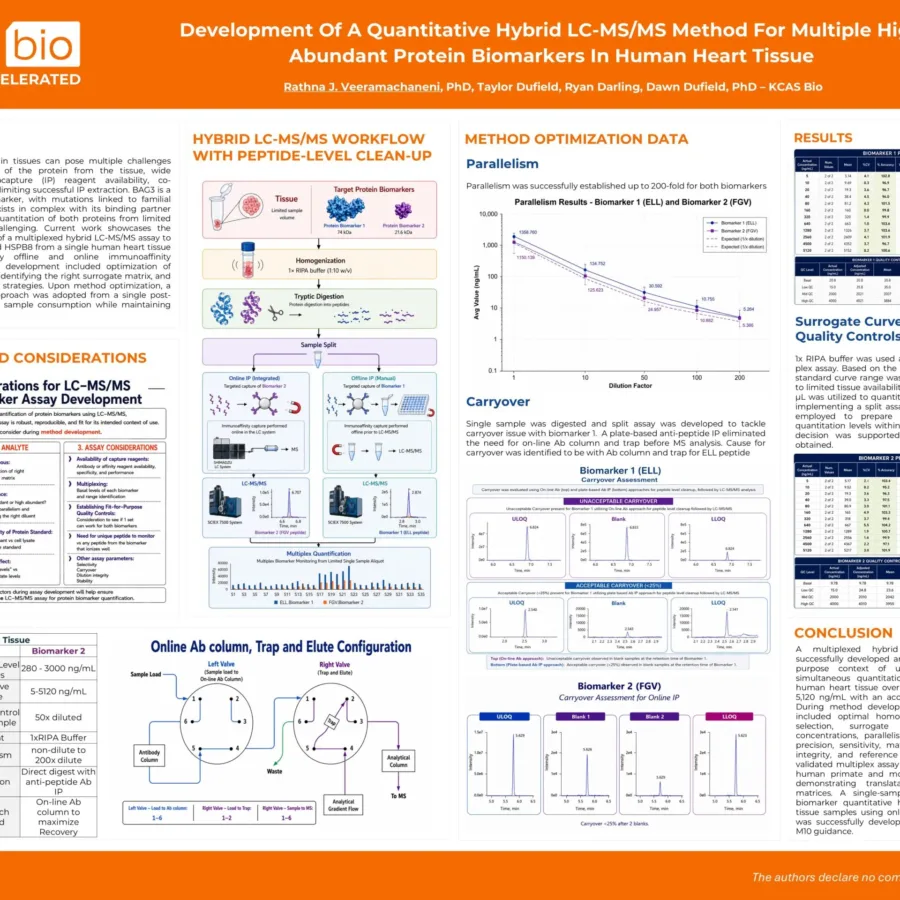
Discover in this poster presented by Rathna Veeramachaneni, Ph.D. at the American Society for Mass Spectrometry (ASMS) Conference in 2026 about the various developmental parameters to consider for fit-for-purpose validation of a novel multiplexed hybrid LC–MS/MS assay for the simultaneous quantitation of two abundant biomarkers in human heart tissue.
 Blogs
Blogs
Oligonucleotide therapeutics continue to reshape drug development by targeting disease pathways at the genetic level. Antisense oligonucleotides (ASOs), small interfering RNAs (siRNAs), and antibody-RNA conjugates (ARCs) are expanding the range of treatable diseases, particularly for targets that were previously considered inaccessible to conventional therapeutics. As these modalities evolve,…