 Blogs
Blogs
In today’s fast-moving drug development landscape, bioanalytical continuity and end-to-end support aren’t just conveniences, they’re competitive advantages. Sponsors navigating complex modalities like gene therapies, ADCs, oligonucleotides, and biologics need a partner who can keep pace with aggressive timelines, shifting priorities, and evolving regulatory expectations. Why Continuity Matters in…
 Blogs
Blogs
Some molecules refuse to be easy to study. In this case, the drug was highly charged, sticky, and extremely sensitive to proteolysis, and previous partner labs had already struggled with it; “they’ve never seen anything like this before!” Keeping the entire process, from method transfer, optimization, validation, and…
 Blogs
Blogs
Developing a robust Pharmacokinetic (PK) assay for biotherapeutics often presents unforeseen biological hurdles. Occasionally, a traditional Ligand Binding Assay (LBA) may yield inconsistent data. In this particular case, the LBA assay was not reliably detecting drug in the matrix, potentially indicating some matrix stability issue during method development. In…
 March 22
- March 25
March 22
- March 25
KCAS Bio will be exhibiting at the Society of Toxicology (SOT) Annual Meeting and ToxExpo, taking place in San Diego, California on March 22-25, 2026. As one of the largest gatherings of toxicologists and life sciences professionals, this event offers a unique platform to connect with leaders in toxicology…
 Blogs
Blogs
Drug discovery is an essential part of the drug development process. Researchers test candidates to identify those suitable for regulated animal studies and, ultimately, clinical trials. Bioanalytical discovery involves assessing a compound’s physiochemical properties,…
 webinars
As the field of biotherapeutics rapidly evolves, the development of advanced conjugated therapies such as Antibody-Drug Conjugates (ADCs), Antibody-RNA Conjugates (ARCs), siRNA/oligos, and antibody-peptide conjugates has gained significant momentum. These next-generation therapeutics offer promising efficacy and safety profiles for treating various conditions, including cancer, rare diseases, and in vaccine…
 Blogs
Blogs
Understanding the intricate relationship between drugs and the human body is crucial for effective medical treatments. Two fundamental concepts in pharmacology – pharmacokinetics and pharmacodynamics – play pivotal roles in this understanding. This blog post will delve into these concepts, exploring their differences and significance in drug development and…
 Blogs
Blogs
What is a generic PK assay? A generic pharmacokinetic (PK) assay, also referred to as a universal PK assay for New Biologic Entities (NBE), is used to measure circulating human biotherapeutics—primarily antibody-based—post-administration across various non-human matrices. These assays are particularly beneficial when drug-specific reagents, such as anti-idiotype antibodies,…
 Podcasts
Dom and John, the hosts of “The Weekly Bioanalysis”, recently returned from EBF in Barcelona where there was a session on Patient-centric Microsampling, which both of them found fascinating. This inspired both of them to decide it was high time to revisit this part of our industry. In spite…
 March 16
- March 20
March 16
- March 20
KCAS Bio is excited to announce our participation in the Society of Toxicology (SOT) Annual Meeting and ToxExpo, taking place in Orlando, Florida on March 16th-20th. As one of the largest gatherings of toxicologists and life sciences professionals, this event offers a unique platform to connect with leaders in…
 Podcasts
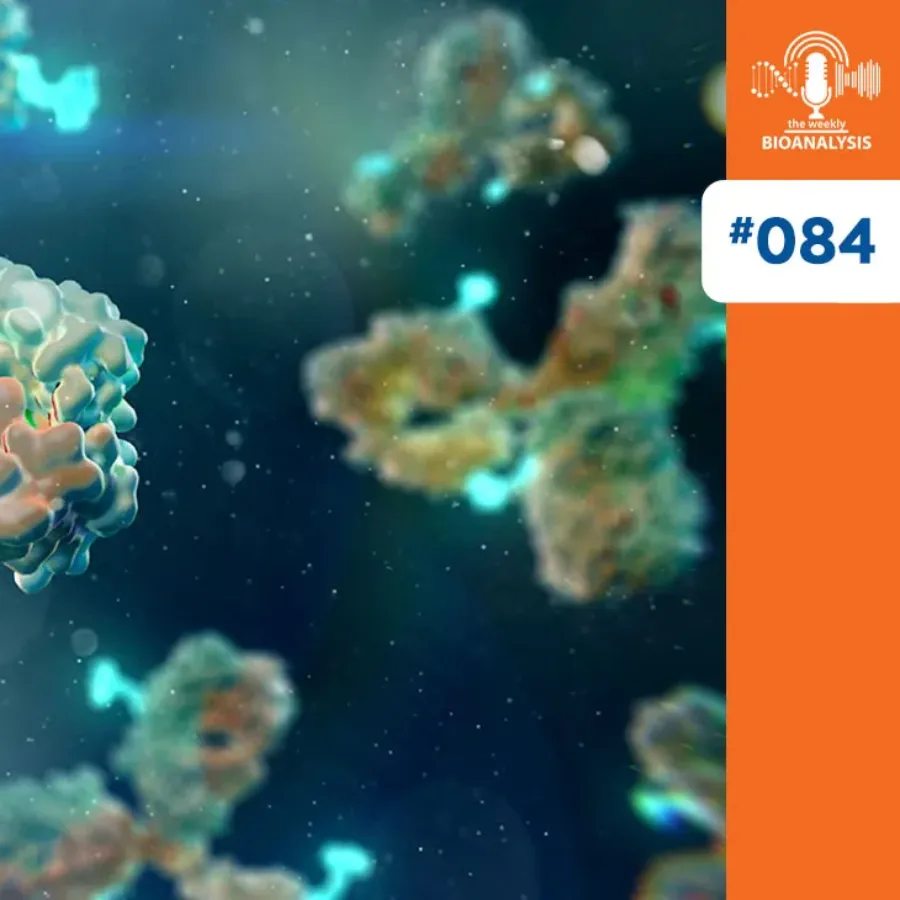
In episode 84 of “The Weekly Bioanalysis”, our special guest, Bryan Parmentier, joins Dom and John to discuss his background and current role at KCAS Bio, offering insights into the field of small molecule method development. He delves into the typical challenges encountered when working with LC-MS analytes, and…
 Blogs
Blogs
What is the Role of Pharmacokinetics (PK) in Drug Development? Pharmacokinetics (PK) is defined as the study of the fate of a new therapeutic entity (NTE) after it is administered into the body of animals or humans. It involves understanding how the drug is absorbed, distributed, metabolized, and eliminated (ADME).