
Accurately quantifying cisplatin in human plasma by LC-MS/MS can be challenging due to matrix effects caused by endogenous plasma components, particularly in hemolyzed samples.
At WRIB 2025, scientists from KCAS Bio and Lilly presented a novel bioanalytical approach designed to overcome hemolysis-related matrix effects during cisplatin quantitation in human plasma.
Understanding Matrix Effects in LC-MS/MS Bioanalysis
Matrix effects resulting from endogenous plasma components are a common challenge in LC-MS/MS bioanalysis and can significantly impact assay accuracy and precision.
Traditional approaches for mitigating matrix effects often include:
- Adjusting analytical methods
- Diluting biological samples
- Transitioning from protein precipitation extraction (PPE) to solid-phase extraction (SPE) or liquid-liquid extraction (LLE)
However, in some cases, these adjustments may not sufficiently address interactions occurring between the analyte and endogenous plasma components.
In this work, investigators evaluated the impact of hemolysis on cisplatin recovery in human plasma samples and developed a strategy to address the interaction between cisplatin and free hemoglobin.
Evaluating the Impact of Hemolysis
Integrated bioanalytical platforms enable selection of the most appropriate analytical method based on scientific need rather than The research team assessed multiple unique lots of human plasma containing varying degrees of visually gradable and non-gradable hemolysis.
During development, the heme group response was monitored in both regular and hemolyzed plasma samples. Observations were consistent with previously documented formation of a cisplatin-hemoglobin complex associated with increasing cisplatin concentrations.

(Effect of hemolysis issue suspected and further tested by serially diluting with regular plasma)
Serial dilution experiments with regular plasma were also performed to further evaluate the suspected hemolysis-related interference.
A Hemoglobin Pretreatment Strategy
After observing promising correction of assay performance through treatment with human whole blood, the team developed a more controlled reagent-based pretreatment approach.
Lyophilized human hemoglobin sourced from a vendor was prepared in saline and optimized to mimic levels expected in human whole blood. Human plasma samples (100 µL) were then pre-treated with 15 mg/mL hemoglobin in saline prior to extraction.
The optimized hemoglobin treatment corrected cisplatin recovery in the presence of varying degrees of hemolysis.
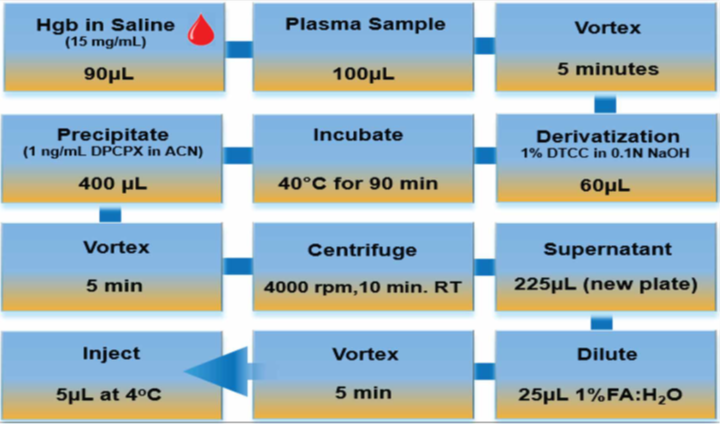
(Final Extraction Procedure)
LC-MS/MS Method Overview
The analytical workflow included:
- Pretreatment of plasma samples with hemoglobin solution
- Derivatization using 1% sodium diethyldithiocarbamate trihydrate (DDTC)
- Protein precipitation extraction using 100% acetonitrile
- Use of 8-cyclopentyl-1,3-dipropylxanthine (DPCPX) as the internal standard
- Acidification with 1% formic acid prior to chromatography
- Reversed-phase HPLC separation using an Agilent InfinityLab Poroshell 120 EC-C18 analytical column
Detection was conducted in positive ion mode using a Sciex 6500 mass spectrometer.
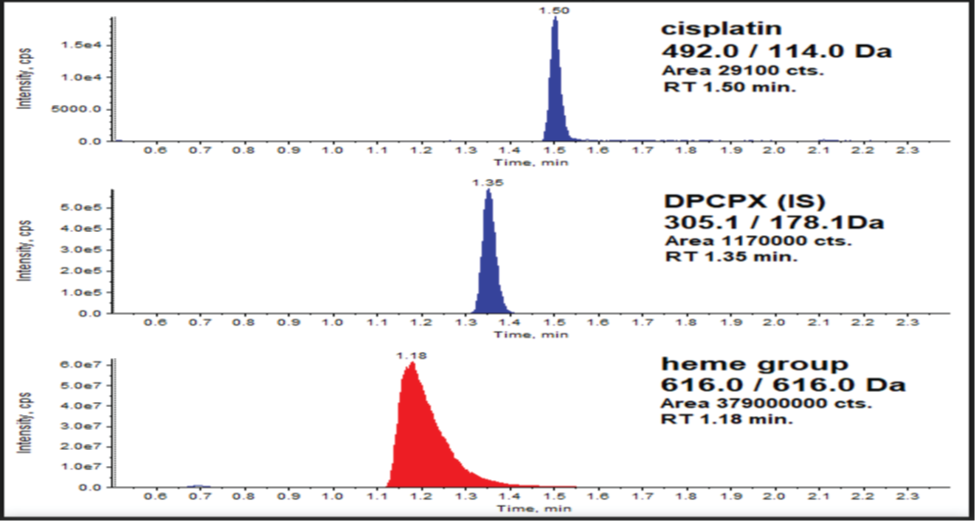
(Cisplatin, DPCPX (IS) and heme group chromatograms and LC/MS/MS parameters)
The assay demonstrated linearity over a concentration range of 2.00 to 2000 ng/mL using a 1/x² weighting factor. Validation results showed strong intra-day and inter-day accuracy and precision performance.
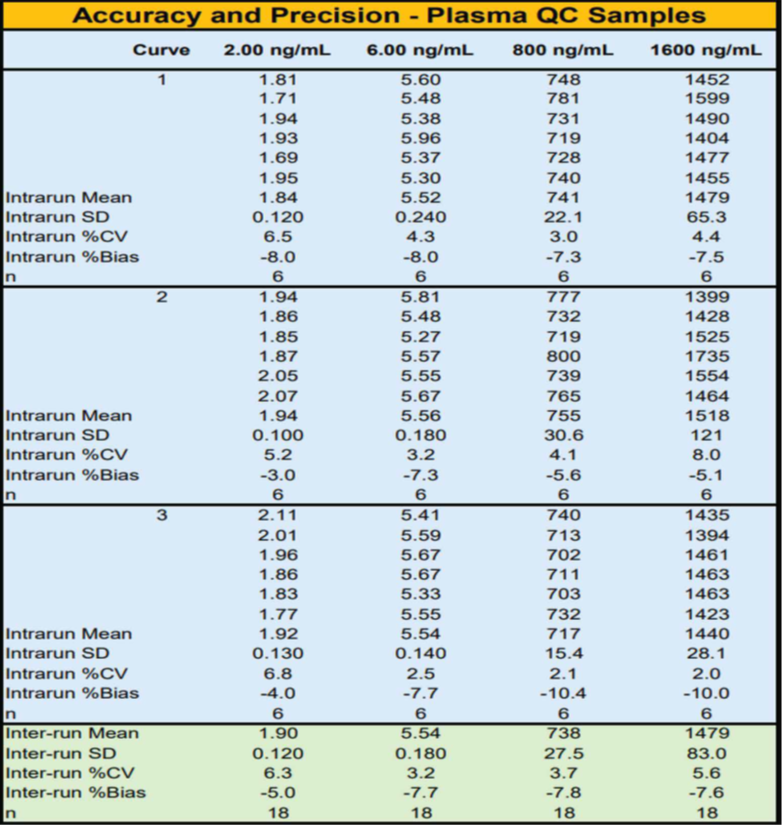
(Validation accuracy and precision results for cisplatin in human plasma)
Supporting Reliable Cisplatin Quantitation
Hemolysis can introduce significant matrix effects that impact assay performance in LC-MS/MS bioanalysis. This work demonstrates an approach for addressing hemolysis-related matrix effects through controlled hemoglobin pretreatment during sample preparation.
The validated high-throughput assay met current FDA and EMA requirements for:
- Selectivity
- Matrix effect evaluation
- Hemolytic and lipemic interference
- Stability
- Dilution integrity
This method will be applied for determination of cisplatin in human clinical samples from patients undergoing solid tumor treatment.
Explore the Full Poster
Additional methodological details, validation data, chromatograms, and workflow information are available in the poster presented at WRIB 2025: Determination of Cisplatin in Human Plasma by LC-MS/MS using Hemoglobin to Overcome Matrix Effects.