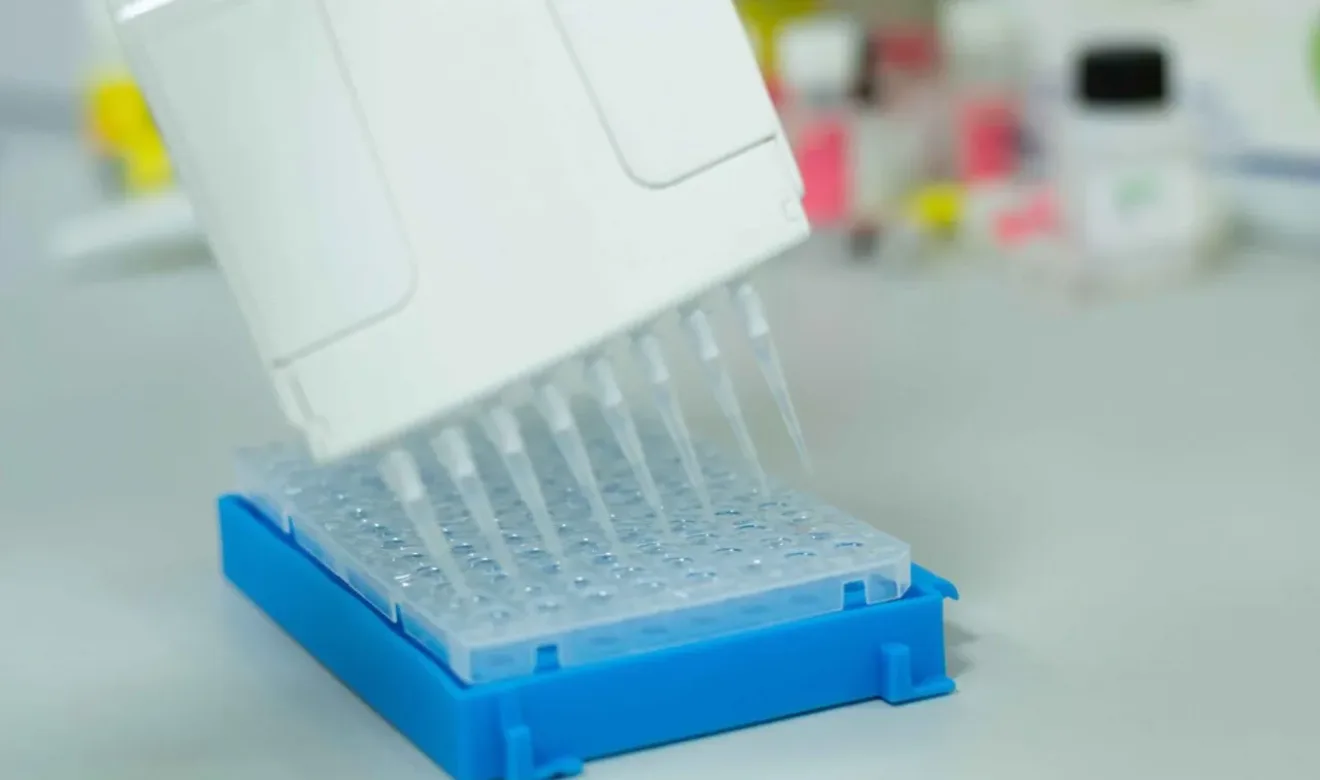
qPCR and ddPCR Assay
From gene therapy to cell therapy or vaccine research, KCAS Bio will provide you with the best support for the development and validation of qPCR and ddPCR assays, delivered through a purpose-built, unidirectional molecular workflow designed for contamination-free, high-quality data.

What is qPCR and ddPCR?
Quantitative PCR (qPCR) is a well-established method for the detection of nucleic acids and the detection, quantification, and typing of different microbial agents. Droplet Digital PCR (ddPCR) delivers precise and multiplexed PCR analysis for absolute quantification. In situations involving low copy number, the need for high precision with rare events, or a requirement for absolute quantification, ddPCR can offer unique benefits compared to traditional PCR methods.
Our molecular services apply to a wide range of applications such as biodistribution, viral vector shedding/quantification, DNA/RNA pharmacodynamic biomarker detection, copy number variation, rare sequence detection, and microRNA profiling. qPCR and ddPCR are increasingly used to quantify genome copy numbers of AAV vectors, commonly used to deliver gene therapies, during pre-clinical and clinical testing, due to their ease of implementation, high sensitivity and accuracy, and high throughput.
qPCR and ddPCR
qPCR Overview
Quantitative PCR (qPCR) is a modification of PCR in which a fluorescent dye is added to the reaction to detect the amount of product present at the end of each heating/cooling cycle.
- qPCR can be performed on cDNA synthesized from RNA for RT-qPCR
- New copies of DNA are detected in “real-time”
- The number of copies of target in the starting sample is determined by a standard curve
- Relative quantitation compares relative fluorescence between samples for the target gene and a normalization gene
dPCR/ddPCR Overview
Digital PCR (dPCR) is a modification of PCR in which reactions are partitioned into thousands of nanoliter-sized reactions.
- dPCR can be performed on cDNA synthesized from RNA for RT-qPCR or RT-dPCR
- Fluorescent signal is measured in each partition with a binary (“digital”) readout of yes or no
- Poisson statistics are used to determine the number of copies of target in the starting sample from the number of positive and negative partitions
Droplet Digital PCR (ddPCR) partitions the PCR reaction into oil-in-water droplets.
qPCR and ddPCR comparison
|
Feature |
qPCR |
dPCR/ddPCR |
|---|---|---|
|
Quantification |
Uses standards for measurements |
Absolute measurement without standards |
|
Sensitivity |
High |
Ultra-high |
|
Precision |
Reliable |
Highly precise |
|
Low Copy Detection |
Good |
Excellent |
|
Copy Number Analysis |
Suitable |
Ideal |
|
Inhibitor Tolerance |
Moderate |
High |
|
Turn-around Time |
Fast |
Slightly longer |
|
Best For |
Routine analysis and screening |
Ideal for rare sequence detection, low-copy targets, or when only limited amounts of input material are available |
KCAS Bio's qPCR and ddPCR expertise
Our team has a long history of collective expertise in sample processing, nucleic acid isolation, and qPCR/ddPCR analysis, supporting pre-clinical and clinical trials across a wide range of species and matrices. Our state-of-the-art facility spans approximately 70,000 square feet (6,500 square meters) and features a controlled, unidirectional workflow with dedicated pre-amplification and post-amplification zones to ensure contamination control, precision, and reproducible data.
This includes two dedicated pre-amplification areas :
- area 1 for reagent preparation and storage
- area 2 for sample preparation and extraction
- area 3 for amplification and manipulation
Our facilities, security, and IT infrastructure ensure your samples remain protected at all times, while cultivating excellence and innovation among our scientists.
At KCAS Bio, we combine technical expertise and capabilities with state-of-the-art operational infrastructure, so we can scale and adapt quickly to the needs of your molecular project.
Our experience and expertise in supporting cell and gene therapy studies and vaccine research, such as shedding assays, potency testing, and biodistribution analysis, is further enhanced by our optimization of pre-analytical procedures: we ensure efficient extraction and consider matrix-specific factors. Additionally, we actively contribute to international discussions on regulatory requirements.
Our people
Related services

Bringing technical innovation to time-critical research
KCAS Bio partners with leading technology providers so our scientists and clients have access to gold-standard, cutting-edge technologies.