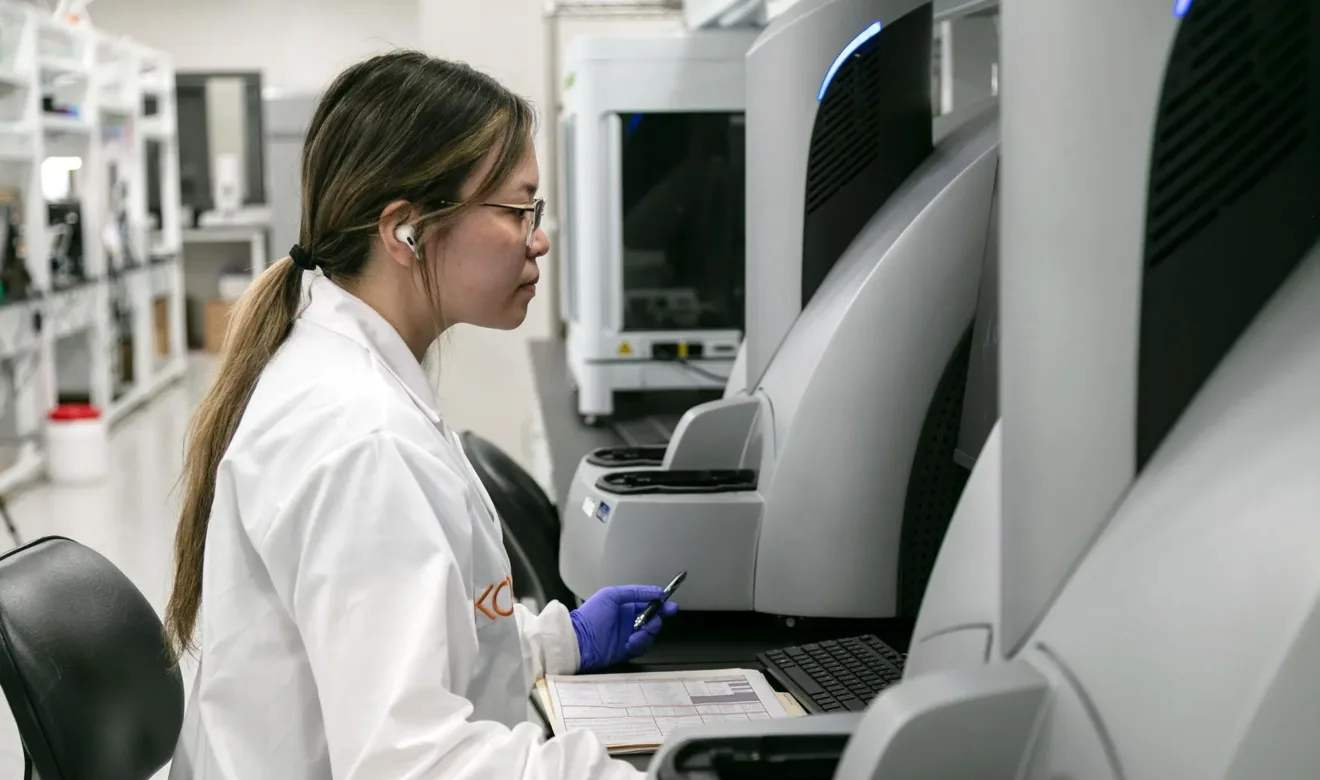
Large Molecule Bioanalysis by LBA
KCAS Bio combines our LBA expertise, advanced technology, and skilled scientists together to deliver tailored assay development from early discovery through clinical studies, working closely with clients at every stage.

KCAS Bio is an industry-leading expert in Large Molecule Bioanalysis, providing precise quantification of proteins, antibodies, and other complex modalities in a wide range of fluids and tissues, from early discovery through clinical development.
Our scientists leverage both LBA and (Hybrid) LC–MS/MS platforms to deliver the right strategy for each program, supported by advanced flow cytometry and molecular technologies – all under one roof for maximum efficiency and insight.
Large Molecule Bioanalysis at KCAS Bio refers to the bioanalysis of any modality with a molecular weight of greater than 10K Daltons. Biologics we support include:
- Monoclonal Antibodies | Bispecifics | Trispecifics | Antibody Fragments
- Peptides & Small Proteins | Cytokines | Fusion Proteins Pegylated Proteins
- Oligonucleotide therapeutics: ASOs | siRNA | RNA | DNA
- Lipids | Glycosphingolipids | Eicosanoids | Steroids | LNPs
- ADC (Linkers & Payloads) | AOC | ARC
- Vaccines: mRNA or DNA Vaccines | Protein Subunit Vaccines | Viral Vector Vaccines | Inactivated or Attenuated Virus
Your bioanalytical partner for LBA services
LBA has been the platform of choice for pharmacokinetic, pharmacodynamic/biomarker, and anti-drug antibody analysis relying on the quality of reagents to help provide sensitive and selective assays. We offer a broad suite of instrumentation and support both plate-based and cell-based assay strategies to align with your program’s objectives.
Dedicated LBA Team
With over 60 full-time LBA scientists, and over 20 years of experience, KCAS Bio brings deep technical expertise, giving sponsors confidence in reliable method development, reducing risk of delays or assay failure.
Diverse LBA Platform Portfolio
A broad suite of LBA platforms including ELISA, MSD, NULISA, Luminex, Ella, SMCxPro, and flow cytometry enables technology matching to each molecule’s requirements, giving sponsors the most scientifically appropriate and efficient path forward.
Reagent Management
Strategic management of critical reagents, including characterization and bridging, maintains assay consistency over long clinical timelines, helping sponsors avoid delays or data comparability issues.
Regulatory-Grade Quality
Regulatory-aware method development proactively manages issues like interference, selectivity, and cross-reactivity ensures the data is robust, defensible, and suitable for GLP/GCP submissions.
From Discovery to Clinical Stages
Our LBA capabilities scale from discovery to clinical stages, allowing sponsors to stay with one partner throughout development, which cuts down on variability and streamlines data continuity.
What is LBA?
Ligand binding assays (LBAs) are specialized bioanalytical methods used to measure interactions between a wide variety of large molecule modalities, such as proteins, monoclonal antibodies, and their targets, or biologics and anti-drug antibodies (ADA). They are essential throughout the development of new biological entities, providing critical insights into pharmacokinetics (PK), toxicokinetics (TK), pharmacodynamics (PD), receptor occupancy, and biomarker responses of therapeutic candidates. By detecting and quantifying these interactions in biological fluids and tissues, LBAs help determine how a drug behaves in the body and its overall therapeutic impact.
Successful LBA development relies heavily on well-characterized ligand binding reagents and careful method optimization to address challenges such as non-specific binding, matrix interference, and cross-reactivity. Modern LBAs have evolved from traditional ELISAs and radioactive assays to include high-sensitivity platforms such as NULISA/Argo HT, electrochemiluminescence immunoassays (ECLIA), MSD, Luminex, and SMCxPRO. These methods are designed to provide robust, reliable data that can adapt as drugs progress through discovery, preclinical, and clinical development.

Your molecule, our expertise. Trust KCAS Bio’s expertise for LBA.
Applications of LBA in drug development
 Therapeutic Areas
Oncology: High-throughput immunoassays support PK, PD, and immunogenicity data for mAbs, ADCs, cytokines, and tumor-associated biomarkers to inform exposure–response models and patient-stratification strategies.
Neuroscience: LBAs quantify low-abundance CNS biomarkers, including amyloid species, tau proteins, neurofilaments, and inflammatory mediators, supporting programs in neurodegeneration or neuroinflammation.
Immunology & Inflammatory Diseases: Quantitation of cytokines, chemokines, complement factors, and autoantibodies to assess immune modulation, inflammatory pathway targeting biologics, and immune toxicities.
Metabolic & Cardiovascular: Troponins, natriuretic peptides, apolipoproteins, and metabolic hormones are efficiently quantified to guide dose selection and safety monitoring.
Rare Diseases & Genetic Disorders: Enzyme replacement, gene-mediated protein expression, and oligonucleotide therapies leverage LBAs to measure expressed proteins, missing enzymes, and disease-driving biomarkers.
Infectious Diseases: Assays track serology, neutralizing antibodies, and protein-based markers of viral or bacterial load, supporting vaccine development and antiviral biologics.
Respiratory: Allergen-specific IgE, inflammatory proteins, and biologic drug levels are routinely measured to evaluate mechanism, safety, and therapeutic activity.
 Phases of Drug Development
Discovery & Early Development: Target identification and early biomarker screening to confirm mechanism of action and identify relevant pharmacodynamic markers.
Preclinical: PK/PD and immunogenicity assessment in animal models to guide dosing strategies and evaluate potential immune responses.
Clinical: PK/PD, biomarker monitoring, and immunogenicity testing across Phase I–III trials to support dose selection, efficacy evaluation, safety assessment, and regulatory submission.
When is LBA the best choice for large molecule bioanalysis?
Ligand binding assays (LBAs) are the go-to choice for large molecule bioanalysis when precise measurement of drug-target interactions, circulating biologics, or anti-drug antibodies is essential throughout drug development. Their flexibility across assay formats and ability to address complex biological matrices make LBAs particularly valuable for supporting PK, TK, PD, and biomarker studies with confidence and regulatory compliance.
High Sensitivity Required
LBA provides very high sensitivity, ideal for low-concentration biologics in plasma or serum.
Established Reagents
When high-quality antibodies or other binding reagents are available, LBA can be quickly deployed with proven specificity.of polar analytes
Routine PK / ADA Testing
LBA is the gold standard for pharmacokinetics (PK) and anti-drug antibody (ADA) assays in clinical studies.
High Throughput Needs
LBA is suitable for processing large numbers of samples efficiently, making it ideal for clinical trials.
Regulatory Acceptance
Widely accepted by regulatory agencies for bioanalytical method validation and submission.
Simple Sample Matrices
Works well when the biological matrix is compatible with immunoassay formats (e.g., serum, plasma).
Long-Term Program Consistency
LBA methods are robust for long-term studies, ensuring reproducibility across multiple batches and sites.
Limited Structural Complexity Required
Ideal when the goal is quantification rather than structural characterization or sequence-level detail.
Technology and instrumentation for LBA
At KCAS Bio, we maintain a diverse suite of advanced instrumentation that enables us to match each project with the most appropriate analytical solution, supporting complex assay designs, high or ultra sensitivity needs, low sample volume requirements, rapid turnaround, high throughput, and study durations of any scale.
Why work with KCAS Bio?

Full-Service Bioanalysis
End-to-end method development, validation, and reporting under one roof.
Regulatory Expertise
Deep familiarity with FDA and EMA requirements.
Cutting-Edge Technology
Advanced electrochemiluminescence, multiplex bead platforms, and ultrasensitive plate-based detection systems.
Flexible, Customized Workflows
Tailored workflows to meet unique project goals and timelines.
Broad Sample Type and Matrix Expertise
Plasma, serum, urine, CSF, and tissues plus unstable/rare matrices.
Global Presence with Harmonized Quality
Consistent technical standards and harmonized operations worldwide
Large Molecule Bioanalysis by LBA FAQs
How do you develop assays for low-abundance biomarkers?
We optimize capture/detection reagents, use sensitive platforms, and refine assay conditions to reliably detect and quantify low-abundance targets while minimizing background noise.
How do you handle anti-drug antibody interference?
We assess ADA impact during method development and validation, implementing mitigation strategies such as assay redesign, selective reagents, or alternative formats to preserve accuracy.
Which detection platforms do you recommend for different targets?
Platform choice is based on target abundance, sensitivity needs, and study scope, with options including ELISA, MSD, Simoa, and multiplexed systems for high-precision measurements.
How do you validate assays for GLP or GCP compliance?
We follow regulatory guidance, performing full validation for accuracy, precision, specificity, and robustness. Documentation and SOP adherence ensure readiness for regulated studies.
Can you support multiplexed ligand binding assays?
Yes, we develop and validate multiplexed assays with minimal cross-reactivity, enabling simultaneous measurement of multiple analytes while maintaining sensitivity and reliability.
How do you manage complex PK/PD bioanalytical requirements?
We integrate ligand binding, functional, and immunogenicity assays into comprehensive PK/PD workflows, providing actionable data to support dosing, safety, and efficacy decisions.
What is your approach to high-throughput sample analysis?
We leverage automation, multiplexing, and streamlined workflows, scaling instrument capacity and staffing to meet large-volume demands while maintaining accuracy and turnaround times.
Additional resources
 Blogs
Blogs
What Are Ligand Binding Assays (LBAs)? Ligand binding assays (LBAs) have been our core activity for decades. LBAs are commonly used to measure interactions between two proteins, a ligand and its receptor, a monoclonal antibody (mAb) and its target, or a biologic and Anti-Drug Antibodies (ADA). What Are…
 Blogs
Blogs
In biomarker-driven drug development, selecting the right assay format is critical for generating reliable data that informs scientific and clinical decisions. Whether quantifying proteins, immune cell subsets, or complex molecular signatures, the choice between off-the-shelf and customized assays has direct implications for timelines, costs, and how well the assay…
 Blogs
Blogs
A pharmacokinetic (PK) assays evaluate how the body affects a specific substance after administration which includes: absorption, biodistribution, metabolism, and excretion. Preclinical (or non-clinical) PK assays play a crucial role in drug development and typically focus on assessing drug safety and maximum tolerable dose. For the development of pre-clinical…

Tell us how we can help with your project
We've earned our reputation for delivering reliable, error-free data. We understand the importance of speed, flexibility, and consistency and only make promises we can keep.